
- Your cart is empty Browse Shop
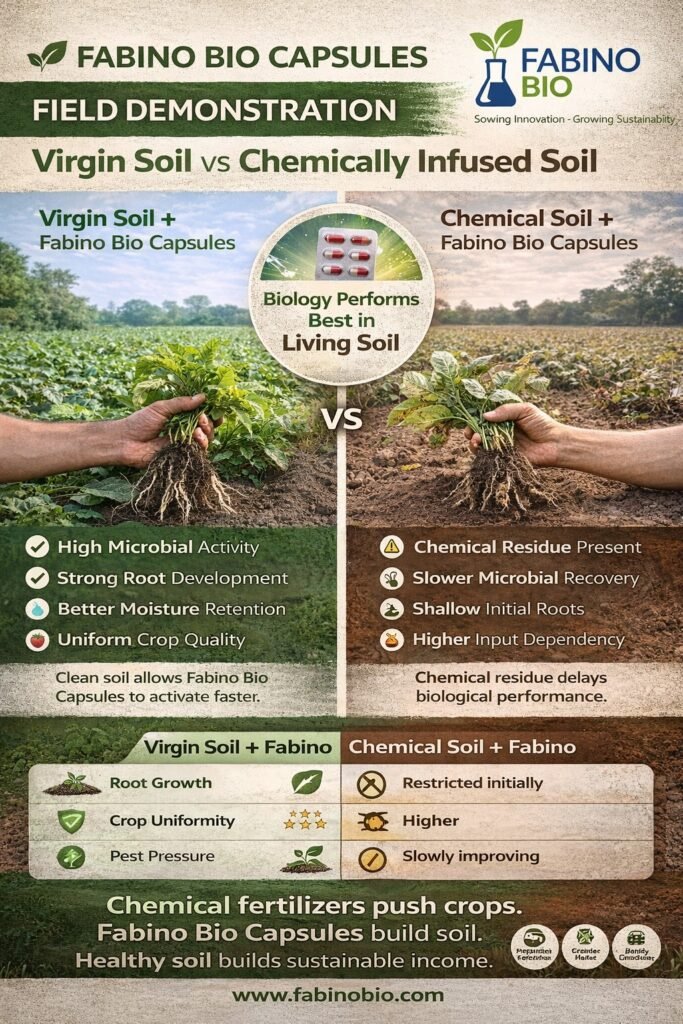
1️. Do organic / bio-fertilizers work faster in virgin (barren) soil?
✅ Yes — in most cases, bio-fertilizers work better and more effectively in virgin or long-barren soils, but with an important clarification about “speed”.
Why virgin/barren soil responds well:
Virgin soil has no chemical toxicity or salt buildup
Soil structure is usually intact (not compacted)
Native microbial life may be low, but not destroyed
No chemical residue suppressing beneficial microbes
When you introduce bio-fertilizers (beneficial microorganisms) into such soil:
They colonize quickly
There is no chemical competition
Soil biology builds in a natural, stable way
📌 Result:
Bio-fertilizers may not give a “shock green-up” like chemicals, but they create strong, sustainable crop response from the first season itself.
2️. What about speed: Bio-fertilizers vs chemical fertilizers?
Let’s be honest and practical.
⏱️ Speed comparison
| Aspect | Virgin Soil | Chemically Infused Soil |
| Chemical fertilizers | ⚠️ Fast initial response, but soil is unconditioned → inefficiency | ⚡ Very fast response |
| Bio-fertilizers | ✅ Slightly slower first 10–20 days, then stable | ⚠️ Often suppressed by chemicals |
📌 Key truth:
Chemicals work fast but shallow
Bio-fertilizers work slightly slower but deeper and longer
In virgin soil, once microbes establish:
Nutrient availability becomes continuous
Root systems become stronger
Crops show uniform growth and better quality
3️. Is there comparison data between virgin soil and chemical-infused soil?
Yes — globally and in Indian field trials (ICAR, FAO-linked projects, regenerative ag pilots), the pattern is consistent:
🌱 Virgin / long-barren soil + Bio-fertilizers:
Faster microbial establishment
Better root architecture
Higher nutrient use efficiency
Lower input requirement
Better crop quality in 1–2 seasons
🧪 Chemical-infused soil + Bio-fertilizers:
Microbial survival is reduced initially
Soil pH imbalance, salinity, and residue affect microbes
Needs detox + transition period
Results improve after 2–3 cycles
📌 This is why conversion farming takes time, but virgin soil performs faster with bio-inputs.
4️. Which is better for sustainable agriculture?
✅ Bio-fertilizers are clearly superior for sustainable agriculture, and virgin soil is the best starting point.
Why bio-fertilizers win long-term:
Build soil organic carbon
Increase water holding capacity
Reduce dependency on external inputs
Improve resilience to drought & heat
Enable low-residue / export-compliant produce
Support carbon farming & ESG goals
Chemical fertilizers:
Give quick yield
Gradually destroy soil biology
Cause salinity, acidity, compaction
Increase cost year after year
Create dependency, not sustainability
📌 Sustainability = soil biology + farmer economics + environment
Bio-fertilizers satisfy all three.